

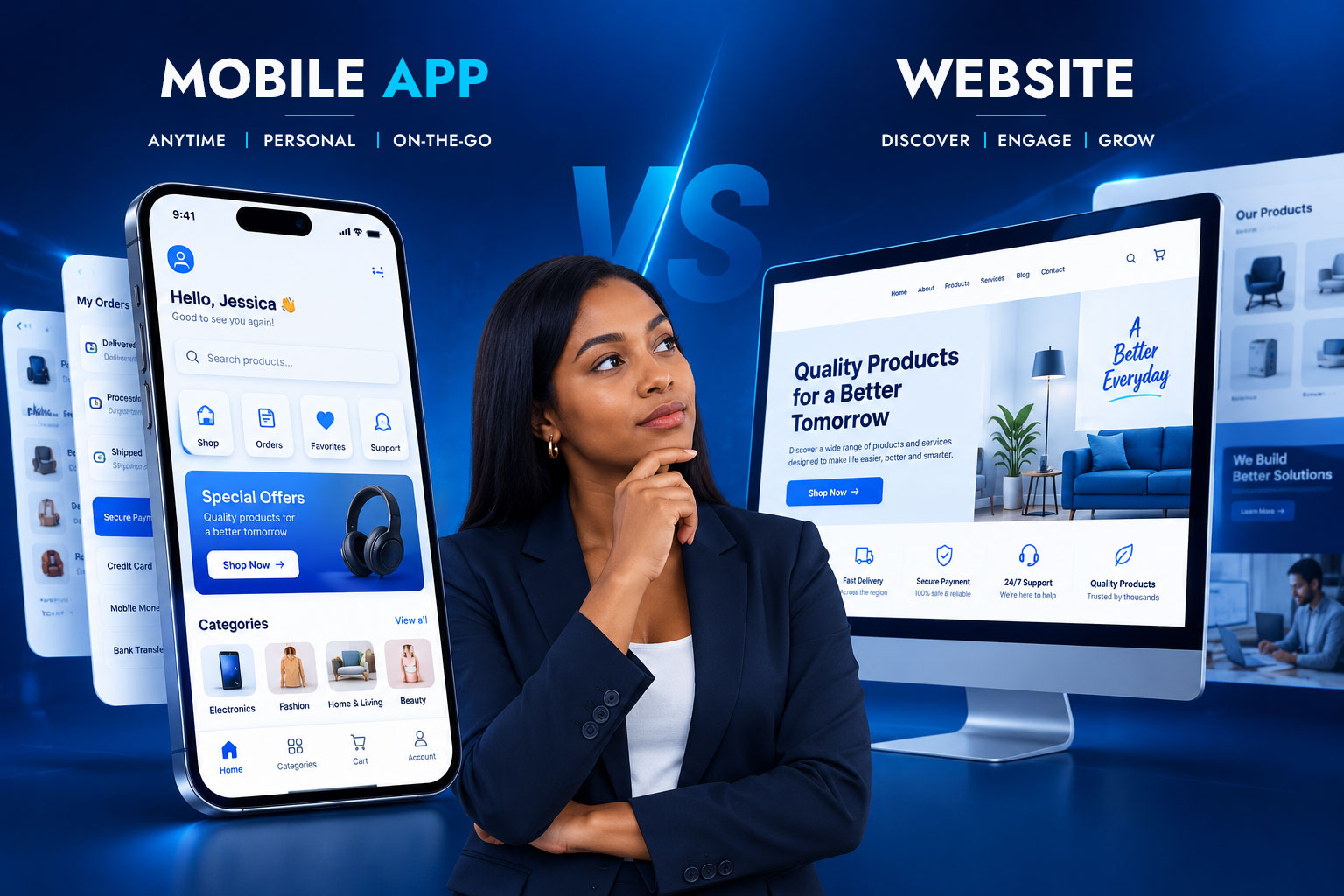
Mobile App vs Website: Which Does Your Business Need?
Businesses increasingly interact with customers through digital platforms, but choosing the right one is not always straightforward.
Should you invest in a website, develop a mobile app, or eventually use both?
The answer depends less on which technology seems more advanced and more on what your customers need to do, how often they need to do it and how they discover your business.
Understanding mobile app vs website can help you invest in the platform that actually supports your business goals.

Website and Mobile App: What’s the Difference?
A website is accessed through a browser and can be opened instantly through a link or search engine without requiring installation.
A mobile app is installed on a smartphone or tablet and is usually designed around more focused, recurring interactions.
Both can deliver excellent digital experiences, but they solve different problems. For a broader comparison, Clutch’s guide to mobile apps, web apps and websites explains how each option differs in functionality, accessibility, engagement and development requirements.
When Does a Website Make More Sense?
A website is often the better starting point when your priority is visibility and accessibility. In the mobile app vs website decision, a website often makes more sense when reaching new customers is the immediate priority.
It may be the right choice if customers mainly need to:
- Discover your business online
- Learn about your products or services
- View your portfolio or company information
- Make enquiries or request quotations
- Book appointments or complete simple purchases
- Find you through search engines
Because websites can be accessed directly through a browser and indexed by search engines, they are particularly valuable for businesses trying to reach new audiences.
For many businesses, a well-designed mobile-responsive website can already accomplish much of what customers need without requiring them to download anything.
When Does a Mobile App Make More Sense?
A mobile app becomes more valuable when customers need to return frequently or perform specific tasks repeatedly.
Consider an app when your business requires features such as:
- Customer accounts and personalized experiences
- Push notifications
- Frequent orders or transactions
- Loyalty or reward programs
- GPS or location-based functionality
- Camera or other device features
- Some level of offline access
- Regular interaction with your service
This is where the mobile app vs website comparison begins to favour an app: the experience depends on frequent, personalized or device-based interactions. For example, a restaurant that mainly needs to display its menu, location and reservations may be well served by a website.
A food-delivery business where customers repeatedly order, save addresses, track deliveries and receive notifications has a much stronger reason to develop an app.
Mobile apps are particularly suited to repeated engagement and deeper integration with smartphone capabilities such as GPS, cameras and notifications.
Mobile App vs Website: A Simple Comparison
| Consideration | Website | Mobile App |
|---|---|---|
| Easy to access | ✓ | Requires installation |
| Search engine visibility | Strong | Limited |
| Frequent customer use | Good | Excellent |
| Push notifications | Limited | Strong |
| Device integration | Limited | Strong |
| Offline capabilities | Limited | Better |
| Updates | Immediate | May involve app-store updates |
| Development complexity | Generally lower | Generally higher |
The important question is therefore not “Which one is better?”
It is:
“What do our users actually need to accomplish?”
What About a Web App?
In a mobile app vs website comparison, a web app can sometimes provide a practical middle ground by combining browser accessibility with more interactive functionality.
A web application runs through a browser but allows users to perform more advanced tasks such as managing accounts, accessing dashboards, processing bookings, collaborating or working with data.
This can be useful when a business needs software-like functionality without requiring every user to install an application. Businesses exploring this middle ground can also learn more about Progressive Web Apps on web.dev, including how modern web experiences can support installation, offline functionality and deeper device integration. Ultimately, the right mobile app vs website choice is the one that solves the user’s problem effectively while supporting the long-term goals of the business.
Do You Need Both?
Possibly—but not necessarily from the beginning.
A website and mobile app can serve different stages of the customer journey.
Your website can help people discover and understand your business, while your mobile app can provide a richer experience for customers who already interact with you regularly.
The mobile app vs website decision also does not have to result in choosing only one platform forever. For some businesses, starting with a strong website and introducing an app when customer behavior justifies it can be a more practical approach than building both immediately.
Start With the Problem, Not the Platform
Choosing between a mobile app vs website should begin with your customers and business processes—not with the technology itself.
Ask:
How will people find us?
What do they need to accomplish?
How often will they use the platform?
Do we need smartphone-specific features?
Will customers realistically install and repeatedly use our app?
A good mobile app vs website strategy should ultimately reflect real customer behaviour rather than assumptions about which technology seems more advanced. Those answers will usually make the right direction much clearer.
At ENMACDO, we design and develop websites, mobile applications and custom digital solutions around the actual needs of businesses and their users.
Have a Digital Product Idea?
Whether you’re considering a website, mobile application or something more custom, we can help you determine the right approach before development begins.
Ready to Build a Stronger Brand Identity?
Talk to ENMACDO →
Frequently Asked Questions
Should a new business build a website or mobile app first?
It depends on the business model. If the immediate priority is visibility, information and customer acquisition, a website can provide a strong starting point. An app becomes more compelling when customers need frequent interactions or specialized mobile functionality.
Can a mobile app replace a website?
Not always. Websites and apps often serve different purposes. A website can support discovery and broad accessibility, while an app can focus on deeper engagement with existing users.
Is a web app the same as a mobile app?
No. A web app operates primarily through a web browser, while a mobile app is installed on a device. Both can provide interactive functionality, but their capabilities and distribution methods differ.
Can a business have both a website and mobile app?
Yes. Many businesses use a website for visibility and acquisition while providing an app for customers who require more frequent or personalized interactions.
Looking at mobile app vs website from this perspective helps a new business avoid investing in functionality its customers may not yet need.
