


AI for Small Business: 15 Practical Ways to Use AI in 2026
Artificial intelligence is no longer something only large technology companies can use.
Today, small businesses can use AI to write faster, understand customers, automate repetitive work, analyze information and improve everyday decision-making.
But the goal isn’t to use AI everywhere. The real value of AI for small business comes from applying it to specific problems where it can save time, improve service or simplify everyday work.
The real question is: where can AI save your business time, improve the customer experience or help your team work more effectively?
Here are 15 practical ways businesses can use AI in 2026.
1. Improve Customer Support
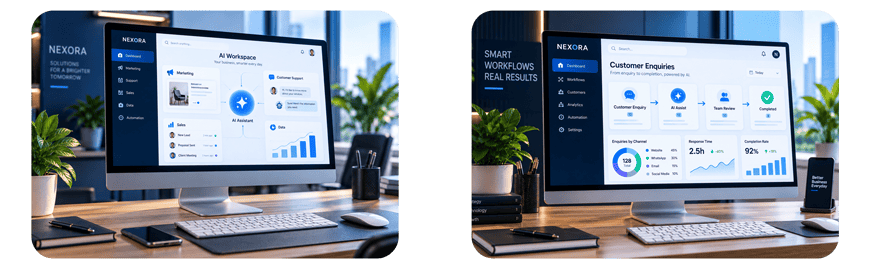
AI-powered assistants can answer common customer questions, provide basic product information and direct customers to the right service. One practical use of AI for small business is handling routine customer questions while keeping human support available for more complex needs.
This can help businesses respond faster while allowing employees to concentrate on enquiries that genuinely require human attention.
AI shouldn’t replace every customer interaction. It works best when routine questions are automated while customers can still reach a person when necessary.
2. Create Marketing Content Faster
Businesses can use AI to help develop:
Social media captions, email campaigns, blog ideas, advertising concepts and product descriptions.
Instead of asking AI to produce everything automatically, use it as a creative assistant. When used carefully, AI for small business can make content production faster without removing the creativity and judgment of your team.
Your team should still review the final content to ensure it sounds like your business and communicates accurate information.
3. Generate New Business Ideas
Sometimes the difficult part isn’t executing an idea—it’s finding one.
AI can help brainstorm campaign concepts, product names, promotional offers, event ideas or different approaches to a business problem.
It can quickly produce possibilities that your team can then evaluate and develop.
4. Research Markets and Competitors
AI can make large amounts of information easier to explore. This makes AI for small business particularly useful when teams need to understand large amounts of market information quickly.
For example, a business could use AI to organize competitor information, summarize industry reports or identify recurring themes in customer discussions.
The important distinction is that AI-generated answers are not automatically facts. Important business information should still be verified against reliable sources.
5. Understand Customer Feedback
Reviews, surveys, support conversations and social media comments can contain valuable information.
When the volume becomes difficult to review manually, AI can help group feedback into common themes such as:
Pricing · Delivery · Product Quality · Customer Service · User Experience
That makes it easier to identify recurring problems and opportunities.
6. Write and Improve Emails
AI can help employees draft routine emails, improve wording, summarize long conversations or adjust a message for a particular audience.
For busy teams, AI for small business can make everyday communication faster while still allowing employees to review and personalize important messages.
This is especially useful when employees know what they want to communicate but need help expressing it clearly and professionally.
7. Support Your Sales Team
AI can help organize sales information, summarize customer conversations and prepare follow-up messages.
For example, instead of manually reviewing several pages of notes before contacting a prospect, a salesperson could use an approved AI system to summarize the important points.
The salesperson still manages the relationship. AI simply reduces some of the administrative work around it.
8. Analyze Business Data
A spreadsheet containing hundreds or thousands of rows can be difficult to interpret quickly. Another valuable application of AI for small business is turning complex business data into information that is easier to explore and understand.
AI-assisted analytics can help businesses explore sales patterns, compare periods, summarize performance and identify unusual changes in their data.
The objective isn’t to replace financial or business analysis but to make information easier to investigate and understand. Businesses that need more specialized systems can also explore custom software development to build tools around their specific processes, data and workflows.
9. Automate Repetitive Administrative Work
Many businesses lose valuable time to small repetitive tasks.
AI and automation can assist with activities such as sorting enquiries, categorizing documents, extracting information, preparing summaries and routing requests to the appropriate team.
Saving a few minutes on a task may seem insignificant, but the benefit becomes much larger when that task happens hundreds of times. Using AI for small business in repetitive workflows can reduce manual work and give employees more time for higher-value activities.
10. Personalize Customer Experiences
Not every customer has the same interests. This is another area where AI for small business can help companies deliver more relevant experiences based on customer needs and behaviour.
AI can help businesses use customer behavior and preferences to provide more relevant product recommendations, content or communications.
E-commerce platforms are an obvious example, but personalization can also be useful for service businesses, websites and email marketing.
11. Improve Website Experiences
AI can also complement professional website design by making websites more useful without turning them into complicated technology demonstrations. When applied properly, AI for small business can make digital experiences more helpful without making the website unnecessarily complicated.
Businesses can use it for intelligent search, customer assistance, personalized recommendations and other features that help visitors find what they need.
The technology should support the customer journey—not distract from it.
12. Create Visual Concepts
AI image tools can help teams explore early ideas for campaigns, layouts, presentations and creative directions.
This can speed up brainstorming considerably.
For professional campaigns, however, businesses should still consider brand consistency, originality, intellectual-property requirements and the quality expected from the final work.
13. Turn Meetings Into Action Points
A long meeting becomes far more useful when everyone knows what happens next. Used this way, AI for small business can reduce the administrative work that often continues long after a meeting has ended.
AI tools can help transcribe meetings, summarize discussions and organize decisions into clear action points.
Instead of employees spending additional time writing meeting summaries, they can concentrate on executing the decisions.
14. Build Internal Knowledge Assistants
Imagine an employee asking:
“What is our procedure for handling a new customer complaint?”
Instead of searching through folders and documents, an internal AI assistant could retrieve information from approved company knowledge and provide the relevant guidance.
For growing businesses, this can make company information easier for employees to access.
15. Make Everyday Work More Efficient
Perhaps the biggest opportunity for AI for small business isn’t one revolutionary application.
It is dozens of small improvements. For additional practical examples, OpenAI’s small-business AI guide demonstrates how smaller teams can apply AI to everyday business activities and workflows.
Writing a proposal faster. Summarizing a document. Organizing research. Comparing information. Preparing a presentation. Finding information inside company documents.
When these small improvements happen repeatedly across a team, the time saved can become significant. If you want to understand the broader impact behind these changes, read our guide on how AI is changing the way businesses work in 2026.
Where Should a Small Business Start With AI?
Getting started with AI for small business does not require transforming every part of the company at once.
Don’t begin by asking:
“How can we put AI everywhere?”
Start with:
“Which repetitive or time-consuming problem should we solve?”
Choose one process. Test whether AI genuinely improves it. Measure the result. Then expand gradually. Businesses looking for a more structured approach can also explore OpenAI’s guidance on identifying and scaling valuable AI use cases across different areas of an organization.
A simple approach is:
Problem → Small AI Solution → Test → Measure → Improve
This prevents businesses from investing in technology simply because it is fashionable.
AI Still Needs Human Judgment
AI can work quickly, but speed doesn’t guarantee accuracy.
Businesses should maintain human oversight when AI is being used for important customer communication, financial decisions, confidential information or other high-impact activities. Organizations that want to develop a more responsible approach can consult the NIST AI Risk Management Framework, which provides practical guidance for identifying and managing risks associated with AI systems.
Employees should also understand what information is appropriate to provide to the AI systems their organization uses.
Responsible use of AI for small business therefore requires clear rules, appropriate data protection and human oversight. The strongest approach is therefore not necessarily AI replacing people.
It is often:
People + AI + Good Processes
Final Thoughts
AI for small business becomes valuable when it solves a real problem.
You don’t need to transform your entire company overnight. Start with one repetitive process, one customer challenge or one area where your team is spending unnecessary time.
Use AI where it creates measurable value—and keep people responsible for the decisions that matter.
At ENMACDO, we help businesses explore practical digital solutions through software development, website development, mobile applications, digital strategy and emerging technologies.
Ready to explore how technology could improve the way your business works? Talk to ENMACDO about your next digital project.
