


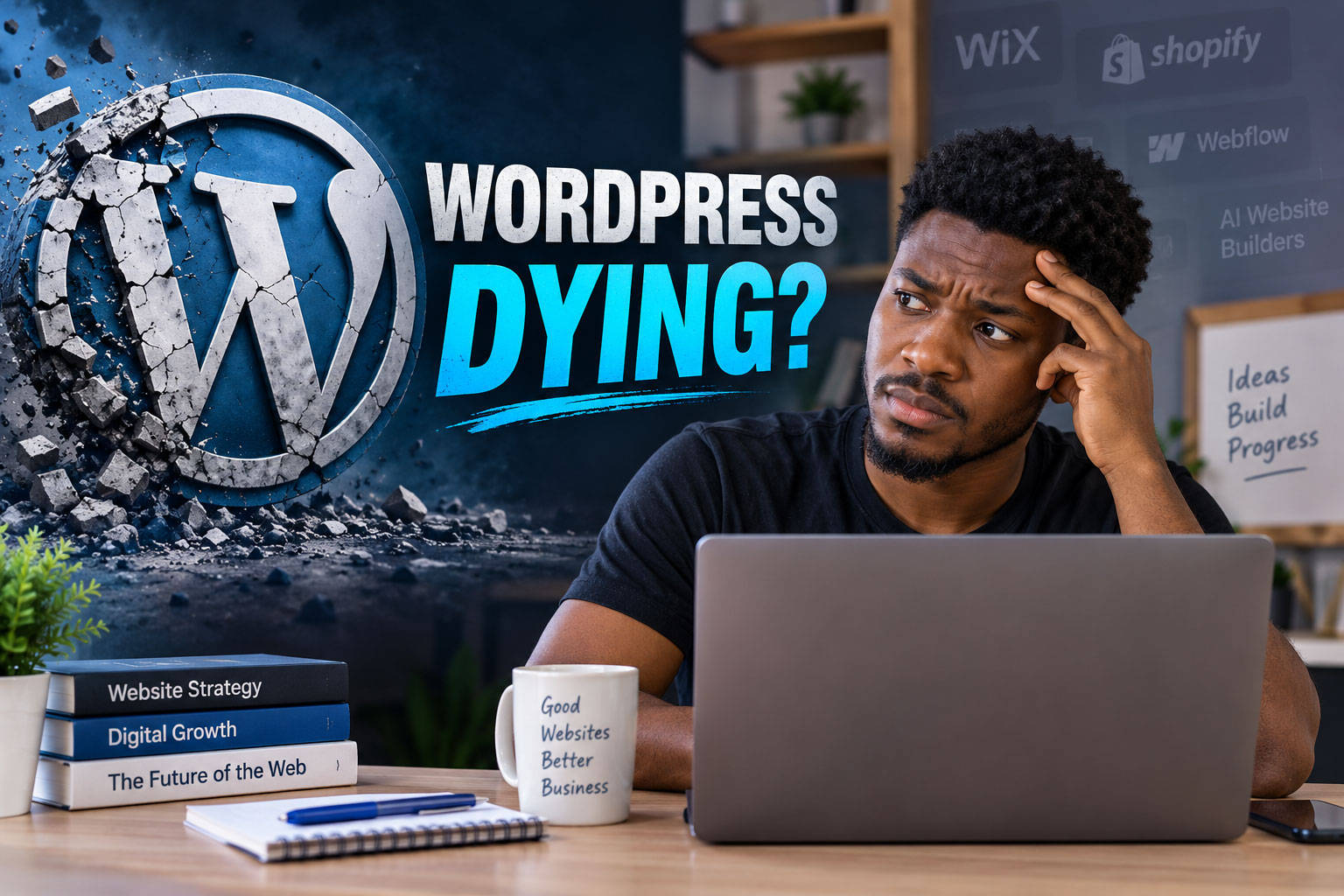
WordPress Is Changing, but Is It Really Dying?
For years, WordPress has been one of the most influential platforms for building websites. But with the rapid growth of Shopify, Wix, Webflow, no-code platforms and now AI website builders, a growing question has emerged:
Is WordPress dying?
The short answer is no—but the website-building industry around WordPress is changing rapidly.
In 2026, businesses have more ways to build and manage websites than ever before. That increased competition is forcing WordPress to evolve while also giving businesses more choices.
The important question is therefore not simply whether WordPress is losing relevance. It is whether WordPress is still a good choice for the type of website your business actually needs.

1. What Does the Current WordPress Market Share Tell Us?
Before declaring that WordPress is disappearing, it helps to look at the numbers.
As of September 2026, W3Techs’ WordPress usage statistics show that WordPress powers approximately 40.7% of all websites and holds around 58.9% of the market among websites using a known content management system.
Those numbers do not describe a dead platform.
WordPress remains considerably larger in CMS market share than platforms such as Shopify, Wix, Squarespace and Webflow.
However, market leadership does not guarantee that a technology will remain the right solution for every business. Competition is increasing, and businesses now expect website platforms to become faster, simpler and more intelligent.
2. Why Are People Asking Whether WordPress Is Dying?
There are several reasons businesses and website owners are increasingly asking, “Is WordPress dying?”
Website builders have become easier to use. Ecommerce platforms provide increasingly complete ecosystems. No-code tools allow designers to create sophisticated experiences without traditional development, while AI can now generate layouts, content and even functional website components.
At the same time, poorly maintained WordPress websites can become slow, difficult to manage or overloaded with unnecessary plugins.
These experiences sometimes create the impression that WordPress itself is outdated.
But there is an important difference between an outdated WordPress website and an outdated WordPress platform. Sometimes the real issue is not the platform at all—the business may simply be experiencing the signs that its website needs a redesign.
A website built several years ago with old plugins, poor development practices and outdated design does not necessarily represent what modern WordPress can do.
3. AI Website Builders Are Changing the Competition
Artificial intelligence is one of the biggest changes affecting website development in 2026. This rapid shift has also intensified the question, “Is WordPress dying as AI-powered website builders become more capable?”
AI-assisted platforms can now help users generate layouts, write content, create images, suggest designs and automate parts of the website-building process.
That makes basic website creation increasingly accessible. Interestingly, WordPress is not ignoring this shift. Its official 2026 roadmap identifies bringing AI across the WordPress experience—with guardrails and user control—as one of the project’s major goals. WordPress 7.0 also established foundations for AI capabilities within the platform.
So AI may not simply compete with WordPress.
It may also become an increasingly important part of how WordPress websites are created and managed.
4. WordPress Still Has One Major Advantage: Flexibility
When people ask “Is WordPress dying?”, one reason the answer remains more complicated than it appears is the platform’s flexibility.
Businesses can use it for corporate websites, blogs, publications, ecommerce stores, membership platforms, educational websites, directories, portfolios and many other digital experiences.
Thousands of themes, plugins and integrations allow developers to extend the platform far beyond a basic website.
More importantly, WordPress is open-source. Businesses are not restricted to the same closed ecosystem offered by many hosted website builders.
That flexibility can be extremely valuable when a website needs to evolve alongside the business.
5. But WordPress Is Not Automatically the Best Choice
Saying that WordPress is still a good choice does not mean it is the correct platform for every project. When businesses ask “Is WordPress dying?”, the answer should not be confused with whether WordPress is the right solution for every type of website.
A business that only needs a very simple website may prefer a managed website builder. A company focused entirely on straightforward ecommerce may find a dedicated commerce platform more convenient. A complex digital product may require custom software rather than a traditional CMS. The platform should follow the business requirements—not the other way around.
A professional technology partner should therefore evaluate the project’s goals, integrations, scalability, management requirements, budget and future plans before recommending WordPress or any alternative.
6. The Real Problem Is Often How WordPress Is Built
When asking “Is WordPress dying?”, it is important to separate problems with the platform itself from problems caused by poor implementation.
Too many unnecessary plugins, cheap themes, weak hosting, outdated software, oversized images and poor development practices can create websites that are slow or difficult to maintain.
That is not unique to WordPress. Poor technical decisions can weaken websites built on almost any platform.
A professionally developed WordPress website should consider performance, security, responsive design, user experience, SEO, accessibility and maintainability from the beginning. This is why our website design approach starts with the needs of the business rather than simply choosing a theme or platform.
The question should therefore be more than:
“Should we use WordPress?”
It should also be:
“How should this website be designed, developed and maintained?”
7. Should Businesses Still Choose WordPress in 2026?
For many businesses, yes. Although “is WordPress dying?” has become a common question, the platform still offers the flexibility, control and extensibility many business websites require.
WordPress remains a strong option when a company needs control over its content, extensive integrations and the ability to expand its website as the business grows.
The platform is also continuing to evolve. According to the WordPress project’s 2026 development goals, work is continuing on collaborative editing, responsive controls and AI integration, showing that WordPress development is far from standing still.
However, businesses should not choose WordPress simply because it is popular. The right platform depends on what the business needs today, how the website will be managed and what it may need to become in the future.
So, Is WordPress Dying?
The evidence does not suggest that WordPress is dying.
A platform powering roughly 40% of the web and almost 60% of websites using a known CMS remains deeply established in the digital ecosystem.
What is changing is the environment around it.
AI website builders, no-code platforms, ecommerce ecosystems and new development technologies are creating more competition and raising expectations for what website platforms should provide.
That competition is healthy.
It pushes WordPress—and everyone building with it—to continue improving.
The Best Platform Is the One That Fits the Business
Businesses should not begin a website project by deciding they need WordPress, Webflow, Shopify, Wix or any other platform.
They should begin by understanding what the website needs to accomplish.
At ENMACDO, we approach website development around the needs of the business first. Technology comes after strategy. Whether the right solution involves WordPress, another platform or custom development, the objective remains the same: create a digital experience that supports the business today and can grow with it tomorrow.
Planning a New Website or Rethinking Your Current One?
Start your project with ENMACDO →
Frequently Asked Questions
Is WordPress still relevant in 2026?
Yes. If you’re wondering “Is WordPress dying?”, current usage and continued platform development suggest otherwise. WordPress remains widely used and continues to evolve as website technology changes.
Is WordPress losing popularity?
WordPress faces stronger competition than it did in earlier years, particularly from hosted website builders, ecommerce platforms, no-code tools and emerging AI-powered solutions. However, it still maintains a substantial lead in overall CMS market share.
Will AI replace WordPress?
AI is more likely to change how WordPress websites are created and managed than simply replace WordPress. The WordPress project itself is actively developing AI infrastructure and has made AI integration one of its priorities for 2026.
Is WordPress good for business websites?
Yes, when it matches the project’s requirements and is properly implemented. Its flexibility makes it suitable for many business websites, although other platforms or custom development may be better for certain projects.